
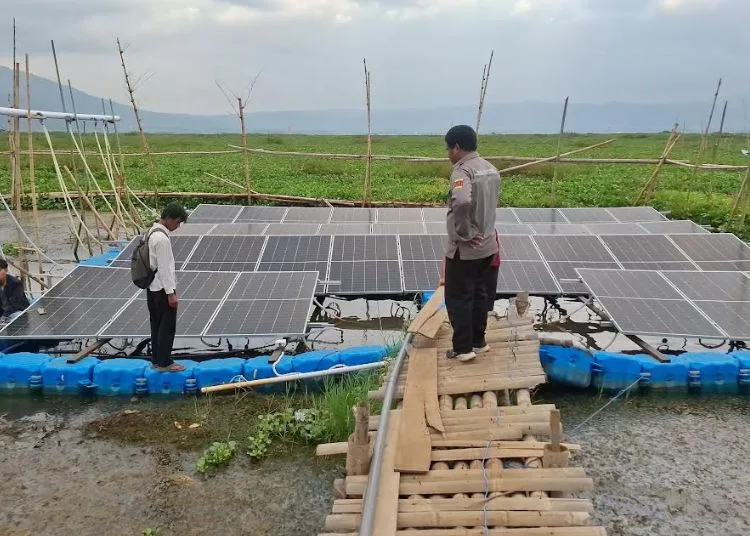
SEMARANG – The Kesongo Village Government (Pemdes) in Tuntang District, Semarang Regency is developing a water or irrigation system by utilizing solar heat or solar energy to meet the irrigation needs of rice fields in the Kesongo Village area, Tuntang.
In the Community Partnership Program (PKM) Scheme activity, the Kesongo Village Government, Tuntang collaborated with Polines Semarang with the activity theme "Community Empowerment to Increase Sustainable Agricultural Productivity Through Smart Farming Based on Rawa Pening Floating PLTS" in the Kesongo Village area, Tuntang, Semarang Regency.
Kesongo Village Head, Supriyadi, stated that the Hydroelectric Power Plant (PLTS) is combined with a series of Solar Water Pumps (PATS) which are expected to irrigate the rice fields in Kesongo Village, Tuntang, especially during the dry season. "Because during the dry season, the water in the rice fields in our village dries up, and the water from Rawa Pening recedes. Therefore, this PLTS device combined with PATS is very necessary in our village," he said on Wednesday, September 24, 2025.
With the solar power plant, Supriyadi stated that the 10 to 15 hectares (ha) of rice fields in Kesongo Village can be irrigated using this innovative tool. "Because when the dry season arrives, these vast rice fields cannot be cultivated. In fact, farmers have to draw water with makeshift pumps if they want to plant rice during the dry season. Because without pumps, there is no water in these rice fields," he explained.
He further stated that if the farmers in Kesongo Village were to manually and independently extract water from Rawa Pening, it would require far greater costs and manpower than the existing equipment built through collaboration with universities in Semarang City.
"We hope that this solar-powered irrigation system will increase food productivity in Kesongo Village," he added.
The Kesongo village head also revealed that the productivity of just one hectare of rice fields in Kesongo Village can produce at least 6 to 7 tons. "It's not optimal if one hectare only produces 6 to 7 tons, because it should produce more than 6 to 7 tons in one harvest season. It should be possible to harvest 12 to 14 tons if it can harvest twice in one season," Supriyadi explained.
He revealed that the less than optimal harvest in Kesongo Village was due to the irrigation system being less than optimal, compounded by the drought factor during the dry season.
"Yes, we admit, our irrigation system is not yet neat and not optimal, which is the cause of the drought, so the river does not have water, Rawa Pening also shrinks during the dry season, so the water is not enough to irrigate dozens of hectares of rice fields in our village," he explained.
For information, the total rice fields in Kesongo Village are approximately 45 hectares on the west side of the village. Of this total, a maximum of 20 hectares can be cultivated.
As a result, 20 hectares of rice fields in Kesongo Village have been rendered unproductive due to a lack of water. As a result, these 20 hectares of rice fields cannot be fully cultivated by the farmers in Kesongo Village.
Therefore, one way to maximize the harvest yields of the rice fields in Kesongo Village is for the farmers there to draw water from Rawa Pening and then channel it to the existing rice fields, in addition to using solar power plants assembled with the PATS system because it is considered cost and energy efficient.
"In fact, if we were to pump water from Rawa Pening independently, the distance from the swamp to the rice fields would be far, plus the costs and labor involved would be enormous, especially since the distance from Rawa Pening to the fields is around 700 meters, making it a real burden for our farmers here," he continued.
Supriyadi hopes that the solar power plant will at least help farmers in Kesongo Village access water to irrigate their rice fields. "Another option is to bring the water source in Rawa Pening closer to the edges of the rice fields. But if this is the most feasible option, then government assistance is needed," he continued.
"Because the system requires a canal to be built so that the water source can be close to the existing rice fields, so that farmers can easily get water to irrigate their rice fields," he added.
Irrigation problems in Kesongo Village in Tuntang, Semarang Regency, occur not only during the dry season but also during the rainy season. Some farmers there also experience difficulty obtaining water to irrigate their rice fields.
This is because, during the rainy season, problems arise from the abundance of water hyacinth that grows around Lake Rawa Pening. Another problem is that the rice fields in Kesongo Village are not being cultivated, as some of them are flooded during the rainy season.
"That's why during the rainy season, farmers always ask the Pemali Juana Watershed Management Agency (BBWS) to clear the water hyacinth that grows abundantly during the rainy season. Only then can farmers irrigate their rice fields using hoses around Rawa Pening," said Supriyadi.
In this way, the farmers in Kesongo Village can only harvest once a year, or even twice, and not all rice fields can produce two or even three harvests in one harvest season.
Meanwhile, Yusuf Dewantoro Herlambang, Lecturer and Supervisor of the 2025 Polines Community Service Program, explained that the program is also related to the National Food Security program currently being promoted by the central government.
"And this program is also a program from the Ministry of Higher Education, Science, and Technology (Kemdiktisaintek) in the field of Saitek from a competition across universities in Indonesia to obtain grants," he explained.
Regarding the PLTS tool, Yusuf said that it is a pump tool for irrigation energy sources that is developed with smart irrigation that utilizes a performance monitoring system from solar-powered water pumps.
"This water pump produces 16 cubic meters of water per second, with a pump efficiency of around 40 percent. This pump is used for irrigation, irrigating approximately 13.1 hectares of agricultural land around Rawa Pening," he explained.
Yusuf continued, saying that the operation, management and maintenance of these tools will be carried out by farmers from various farmer groups and communities in Kesongo Village.
Regarding the development of the PLTS, it was deliberately chosen to be carried out in Kesongo Village, because it is clear that the villages on the outskirts of Rawa Pening, including Kesongo Village, have the potential for the development of the PLTS equipment.
"And in the dry season here, there is almost no water to irrigate the rice fields. It is estimated that the water level of Rawa Pening, which farmers usually use to irrigate their rice fields, has receded by almost 2 meters," he continued.
In addition, he said that ideally, farmers should be able to harvest up to three times a year, and this does not happen to the farmers in Kesongo Village.
"It is hoped that this pump will irrigate the rice fields during the dry season, because farmers here use diesel pumps during the harvest season, which automatically means they buy diesel fuel. The cost of diesel fuel for one four-month harvest period is approximately Rp 2.3 million," he explained again.
Therefore, Yusuf added that with the presence of this PLTS water pump, operational costs of up to IDR 2.3 million will be eliminated because they have been replaced with a PLTS water pump.
"That way, the Rp 2.3 million that would normally be spent on diesel fuel and other equipment can be used for other things to develop agriculture in Kesongo Village, Tuntang," explained Yusuf.
"This will help farmers here become more prosperous, as this solar power plant relies solely on the heat of the sun to generate water for irrigating the rice fields in Kesongo Village," he concluded.
Source: Lingkaranjateng.id